






Marine Protected Areas
- Goal: Educate the community and strengthen the Marine Protected Area Network--special places that restore the health of our marine ecosystems, and promote ocean stewardship and sustainable recreation
- Year Started: 2001
- Partner: Santa Ynez Band of Chumash Indians, National Resource Defense Council, Santa Barbara Channel MPA Collaborative

Marine Protected Areas (MPA) are underwater parks – special protected places in the ocean – designated to safeguard our ocean wilderness. These underwater parks protect critical habitat including rocky reefs and kelp forests, providing safety for thousands of marine plants and animals. MPAs also support diverse recreational opportunities for swimming, diving, boating, kayaking, nature watching, and limited fishing.
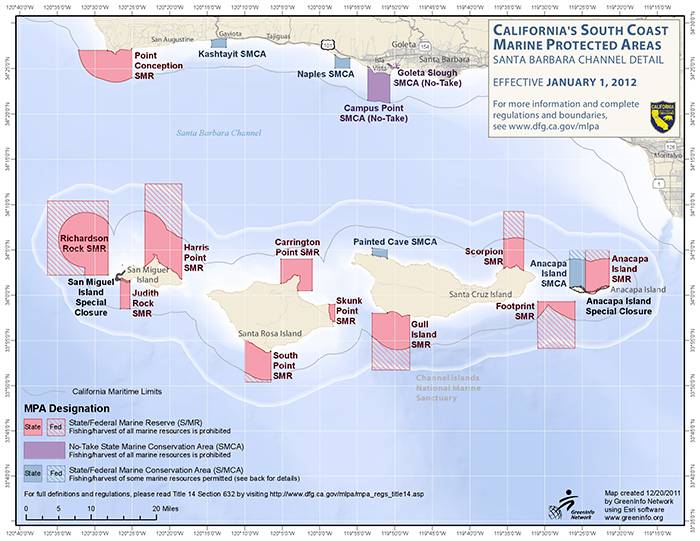
Through our role serving as the Conservation representative on the Channel Islands National Marine Sanctuary (CINMS) Advisory Council, EDC helped lead the regional conservation community through the multi-year process that resulted in establishing this network of MPAs in 2012. This network around the Santa Barbara Channel Islands protects approximately 20% of all Sanctuary waters. Today, the Channel is a special and unique place with thirteen MPAs at the Channel Islands and five along the coast.
Working alongside the Santa Barbara MPA Collaborative and other local and state partners, EDC continues to coordinate and build support for our local MPAs by maintaining open communication with a diverse group – including members from agencies, science, policy, fishing, and tribal communities. This work includes educating the public about ocean stewardship and the need to support businesses and activities that encourage responsible recreation inside and outside of protected areas.
California completed the first ten-year review of its MPA network in 2022, which showed that MPAs are enhancing biodiversity, helping fish populations thrive, and even increasing California’s coastal ecosystem resilience to warming ocean temperatures. Following the evaluation, California Fish & Game opened a public process to address how to adapt management of the MPA network as we face continued changes in ocean conditions. EDC submitted two MPA petitions for consideration: 1) to create a new MPA off of Carpinteria, named for the Chumash village of Mishopshno (Mee-shop-shno), and 2) to strengthen the existing Anacapa Island State Marine Reserve to better protect restored eelgrass meadows.
MISHOPSHNO MPA
This petition is to create a new MPA–Mishopshno–in the coastal waters off Carpinteria—a 1.6 mile-long rocky reef that supports an amazing kelp forest and sandy beach bottom that is important habitat for the abundant marine life. This MPA will fill a 64-mile spacing gap between Campus Point and Point Dume MPA to promote network connectivity, protect habitat important to marine wildlife including juvenile white sharks, and will advance Tribal co-management to the Santa Ynez Band of Chumash Indians (SYBCI). This petition was submitted with our partners SYCI and the National Resource Defense Council.
View Factsheet
 ANACAPA ISLAND STATE MARINE CONSERVATION AREA
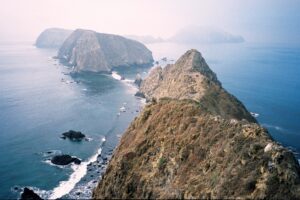
EDC petitioned the California Fish & Game Commission with proposed adjustments to the management of the Anacapa Island SMCA to prevent a rapid decline in the eelgrass meadow. Scientific studies that took place during the 10-year review process demonstrate that seasonally occurring lobster trapping and anchoring in the Anacapa Island SMCA is destroying eelgrass beds that are thriving in the adjacent Anacapa State Marine Reserve. The decline in eelgrass is especially present at Frenchy’s Cove which historically sustained the largest eelgrass meadow around all Anacapa Island. EDC’s petition provides the following three potential solutions:
- Change current regulations to disallow commercial lobster fishing year round;
- Change current regulations to disallow hard bottomed fishing gear near eelgrass meadows; or
- Change the existing border, prohibiting the deployment of lobster traps from 0-50 feet instead of the existing 0-20 feet deep.
*The original ask in the petition was to prohibit lobster traps from 0-98.43 feet/30 meters, however it was revised.